
Weekly round-up
Hey friends, welcome back to Frugal Chic - where financial intelligence meets luxury. Ready to build wealth together this week?
In this letter, we’ll discuss
Why Gen Z hates working
Warren Buffett stepping down as Charmain and CEO of Berkshire Hathaway
The two main issues behind Gen Z’s sentiment
“It is never too late to improve ... Decide what you would like your obituary to say and live the life to deserve it.”
But first, what I’ve consumed over doomscrolling:
Why do we work?
Well the most obvious reason is to stay alive.
Unless we’re born into some kind of generational wealth, most people work to survive because if they didn’t - they woud have no means to put food on the table.
The same goes for our ancestors, who hunted or gathered resources.
Sounds pretty obvious, right?
Now that looks like passive aggressive emails or being an excel final boss.
It’s safe to say there is a concensus that Gen Z hates working. This quote by Maya Sulkin in The Free Press, pretty much sums-um why:
“Influencers being so open and honest about making 4x as much as their old 9-5s, and having such flexible lifestyles, has opened my generation’s eyes into what’s possible,” said Daniel Hayon, 23. “It makes you feel completely disillusioned, and it’s made Gen Z nihilistic about working.” Maya Sulkin in The Free Press
While it could be social media as the defining factor, there’s also some others to consider. As a fellow Gen Z, our coming of age has come at a time where AI is threatening jobs, we missed 2 years of our lives to COVID 19, housing markets and the dwindling of entry level jobs are key factors in this sentiment.
Work can be so much more fulfilling and let’s see an example of someone who stuck at it for 60+ years.
What keeps people working in later stages of life?
I recently read at article by Yahoo Finance, At 95 years old, the legendary investor, Warren Buffett is stepping down from his position as chairmain and CEO of Berkshire Hathaway.
Warren buffett must have felt immense job satisfaction to stay at it for more than 6 decades. To put this into perspective, he has been spearheading Berkshire Hathaway since before Sam Altman, Elon Musk, and Mark Zuckerberg were even born.
The conference board at Berkshire Hathaway reported a higher number of people aged 55+ who enjoyed their jobs compared to the younger generations, for the reasons mentioned piror, it seems obvious why (source).
What I have taken from this is that there is a difference between work for survival and work for purpose.
This is what people mean when they speak about ‘dream jobs’.
Gen Z’s response is that ‘I don’t dream of labour’.
Whatever challenges we’ve faced as a generation, I think we can all agree that it’s hard to achieve our potential with that attitude.
I personally think the frustration is misdirected.
How Gen Z can love work again
Most people that have this attitude towards work, haven’t found the thing that makes them tick. I’ll give you a few scenarios.
Person A: Living paycheck to paycheck. Working to pay bills, they don’t have much money left over to ‘have a life’.
Person B: has a job they despise, but they have a mortgage or a kid (yes, some Gen Z have kids - crazy) so they stick at said job because they’re trapped in a comfortable hell.
Person C: Doesn’t know what they want to do. They’re doing a job just to figure things out.
The issue with all of these people is they can’t get past the safety stage of the hierachy.
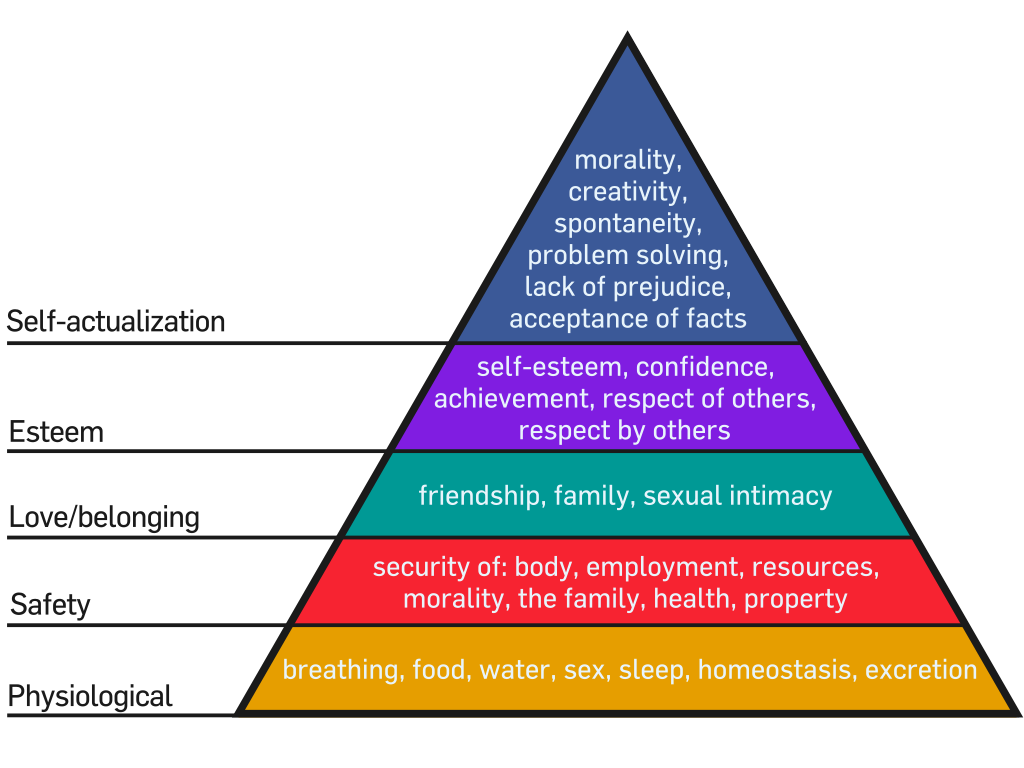
In order to self-actualise, one has to create a sense of mastery - comprehensive knowledge or skill in a particular subject or activity.
Now, I don’t know about you, but I can’t cultivate that for something I don’t care about. Think back to secondary school, your favourite subject was the one that fascinated you, almost feeling emotionally attached to.
The same is true of work.
The answer isn’t simple, but I think more people need to pursue what truly fascinates them. That doesn’t mean doing anything radical, quitting your 9-5 to be an influencer. However, you can develop this sense of mastery from a hobby or side hustle that could eventually turn into your life’s work.
‘Influencers don’t work hard’
Ok, I want to squash this once and for good. Being an influencer is inherently an ‘easy’ job when compared with heart surgery or working at NASA. Sure.
What we forget is social media replaced TV.
When you make videos you’re making your own digital channel.
That means, you control the set, the lighting, the script, the idea, the branding, the tone - you are mastering so many skills at the same time. When you create an advert for a brand, you get paid a lot for it, but think how much it would have cost for a billboard or TV AD.
Sulkin writes “When you spend hours each day watching influencers get rich without much effort, you forget what it takes to succeed in this world.”
The key thing there is without much effort, but when one actually comes to post every single day perhaps alongside their 9-5, you quickly realise it’s not as easy as it looks.
It takes courage to be judged by the world, commodifying yourself into a digestible avatar and juggling all said skills at once.
Yes, it’s a great life, fully flexible schedule - but there is effort involved.
I have always said that one should try some form of creation. Not necessarily getting in front of the camera to speak but blogging, crocheting, photography, some form of creative output, whether it leads to monetisation or not. The goal should be autotelic - (of an activity or a creative work) having an end or purpose in itself.
For me, this meant speaking about personal finance on TikTok, which I had no former qualifications in, I just liked it. Plus I wasn’t breaking down economic policy or expert trading advice, I was simply just explaining in my own terms how the stock makret worked or how to budget - really beginner level stuff. That eventually lead me to become an ‘influencer’ but I as many people started from 0, when it was cringy and I have 0 credibility.
A two-pronged issue
The issue for Gen Z is, in my opinion:
Lack of agency: the ability to get up one day and say ‘I am going to make that happen, without permission’
Lack of experimentation: simply finding what one likes or the curirosity to learn and connect ideas
In an age of cancel culture, digital overload and influencer fatigue - it’s hard to find the motivation to find your life’s work or purpose or put yourself out there. My dream would be to find something I feel so driven for, that I work until 95 like Warren Buffett.
For a while I said I wanted to retire by 40, the truth is I just hated my job and was looking for a way out. Now that I became one of those said ‘influencers’ I don’t feel that way, I feel that my life and work can go in so many difference directions which I am excited for and totally in control of.
It’s a massive privilege but also, it is just running a business - which people forget.
I would say, the solution to this would be that Gen Z needs to be more experimental. Go on more side quests. Let a topic consume you. Become obsessed. Pursue that thing relentlessly and give back to those one step behind you.
(there really is not straightforward answer, I just found the article about Buffett and felt inspired :))