

the art of saving
the frugal chic method

Everyone online seems to be stressing the importance of saving, you see young people like myself making content with over £100k in their investment accounts and you wonder how they even got there.
Saving to a lot of people feels like having to eat the veg on your plate or going to the dentist - a boring, but necessary part of being financially healthy. My personal belief is you won’t reach an ambitious goal by thinking that you ‘ought to’ do something - it must come from a desire.
I recently went on The Curve podcast to discuss my outlook on personal finance. One point that I made was someone who identifies as a ‘saver’ won’t find it difficult to not buy excess coffees, lunches out, impulsive fast fashion buys because it’s not in their identity. It’s not punishment or restriction - it’s a reward. Start from 7:40 if you want this specific topic.
This is a foreign concept to a lot of people, who believe that more is always more. If you get a pay rise, that means an extra holiday, a designer bag or being able to get your lunches from Atis everyday. Now I am not demonising those things or the art of enjoying yourself. However, I have learnt from personal experience, that often the things we are chasing with money, don’t always bring us happiness. Often excess consumption can lead to feelings of emptiness. Saving has given me great satisfaction and i’ll explain why.
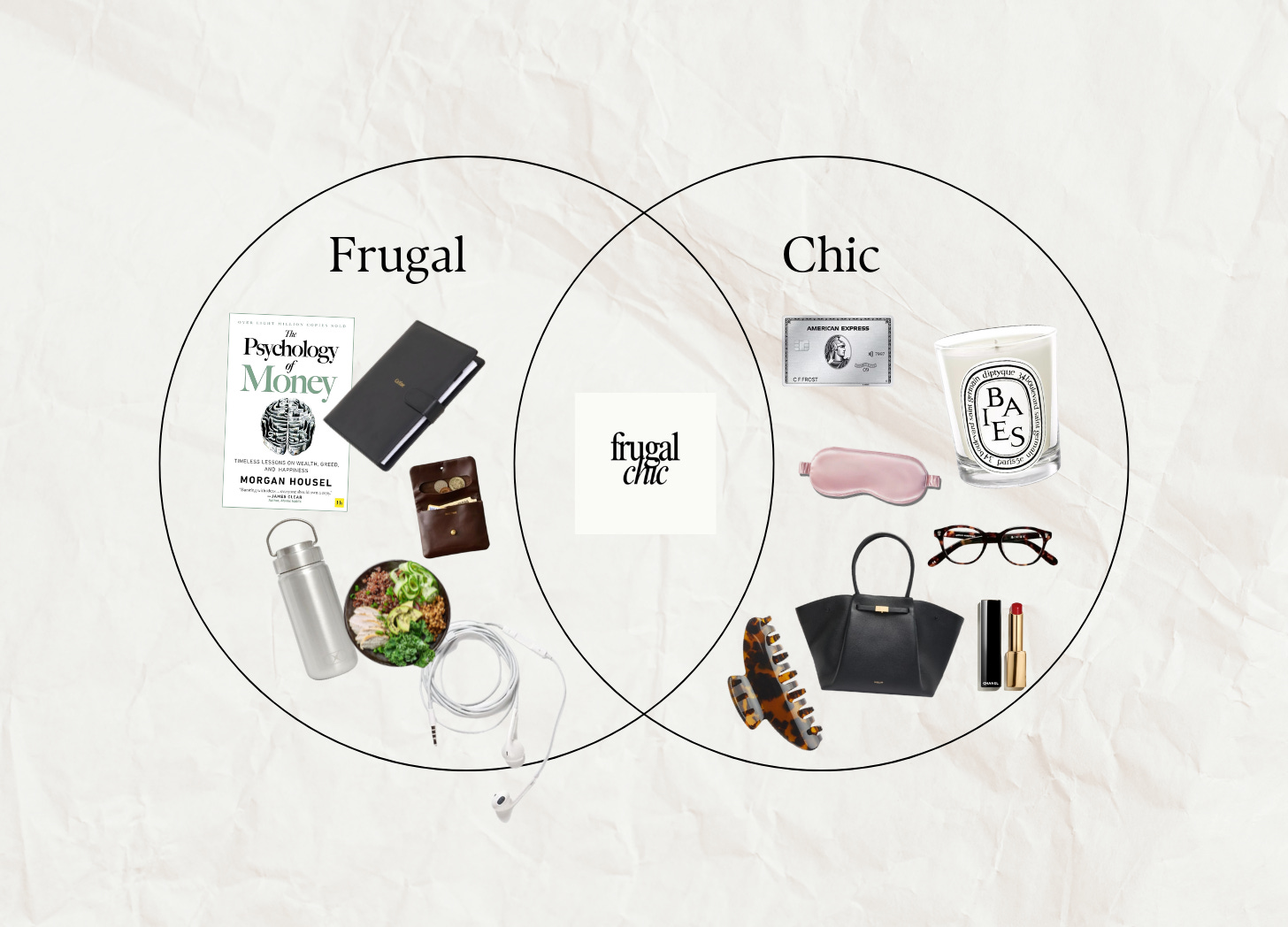
I’ve found solace is a more simple approach, Frugal Chic. Being frugal doesn’t have to mean depriving oneself. In fact, i’d equate frugality to savviness and mindfulness. A lot of frugal content displays an extreme way of living, which I feel, puts the average person off. There has to be some balance. Frugal Chic is about splurging on what matters to you, but removing what doesn’t.
Be chic where it counts. Be frugal where it doesn’t.
Therefore, let’s discuss the mindsets that a ‘saver’ has and how to create desire for this new identity.
The problem - what happens when you overspend
In order to establish any goal in life you must first create an anti-vision. What don’t you want? When you overspend, two things can happen.
You get into debt: klarna or credit cards create this overbearing feeling that you don’t own your future, you owe it instead.
You end up living paycheck to paycheck, relying on your next payslip for the survival of you. You are existing, not living.
These are both situations we can all agree we want to avoid. However, just because these rules are simple, it doesn’t make them easy. Now of course, I am only talking to a specific set of people, as we know, we cannot budget our way out of poverty. So this is to those who might be on a moderate or average salary.
I knew that when I got to university and had to budget my modest student loan, that had to stretch me until the end of the year. I worked backwards to figure out how much I coud afford while my housemates were splurging on Deliveroo, vapes and drinks. Getting into overdraft or using Klarna was normalised. This isn’t me saying I am better than those people, it’s me figuring out what I didn’t want to happen.
Creating an anti-vision can look something like this.
I want to avoid:
Feeling regret from purchases → in future, i’ll keep a wishlist and take the time to decide.
Using a credit card when I feel I deserve a treat → saying no to myself is sometimes a yes in disguise, I can find joy in what I have through gratitude and I can still buy things I want, I just don’t need to say yes to all of it.
Buying designer goods that made me feel empty → Instead, I can get validation from other ways, being a charismatic, empathetic person who focuses on their own goals, not making some brand richer.
It’s always good to put the solution to the problem instead of making it purely negative.
In addition to this, I am very critical when it comes to making a purchase, I consider:
Cost per use - will I use it enough to justify the expense?
The effort to maintaining it - does it need cleaning, recobbling, renewing?
The space it takes up - is it worth the clutter
Is it environmentally friendly or ethical - most things aren’t and therefore, aren’t worth parting your cash for (sure I am not perfect, I still buy some things from fast fashion retailers, but I make sure it ticks all other boxes so I can have it for years)
Am I buying it to please myself or others - if it’s the latter, it likely will lead to disappointment.
Would I stay an extra hour at work for it? This is just an example of how often we forget earned money was once exchanged for our time. A designer bag doesn’t cost £2,000, it costs a month of your life.
Most purchasable goods in our day and age won’t meet all of those standards, so I buy things very rarely.
Creating desire - how to have an identity shift
How does one cultivate the desire to want to save? How do you go from seeing it as the vegetables to instead the meat? I use the analogy of diet because that’s what most people struggle with. Seeing it as a diet, which are usually restrictions on your everyday habits.
A lifelong vegan doesn’t crave meat because they made a conscious to eat plant based. A gym bro doesn’t crave sitting inside all week playing video games, he wants to be in the gym.
We are already discplined in the things we are pursuing, we just know deep down they may not be what we truly want.
Creating desire for saving comes from learning of the benefits.
The main benefits I see:
Early retirement - in my instance, this is a goal of mine. I don’t want to wait until i’m 65 to retire and enjoy total freedom, I want it earlier, in my mid 30s.
I can walk away knowing I have a safety net: it’s means I don’t need a job, relationship or parents to support me financially. If you’re confused about the job part, I mean I could wait 6 months before finding another income source.
I feel confident, confidence comes from being good at something. It sounds shallow or sad to feel confident about being a saver, but to me it comes with great satisfaction to know ‘I am good with money’.
I can achieve my goals, whether that’s buying a home, starting a business that requires upfront capital - it’s all within the realms of possibility.
Building the saving muscle
James Clear explains that habits don’t start with motivation or discipline. They start with identity.
Every action you take is a vote for the type of person you believe yourself to be. And the reason saving feels so hard for so many people is because they’re trying to do the behaviour without becoming the person.
Here’s how I would apply his framework to saving:
1. Make saving obvious, not dramatic
Most people do everything in one go. New budget, new rules, no fun allowed. It feels intense, so it doesn’t last.
A saver doesn’t do dramatic. They do boring, small wins.
That might look like:
an automatic transfer on payday
one account clearly labelled “future me”
a direct debit you barely notice
When saving is visible but unremarkable, it stops feeling like effort.
2. Make saving attractive by linking it to identity
Behaviour sticks when it reinforces who you think you are.
Saving becomes attractive when it’s no longer about sacrifice, but self-respect. Each time you don’t spend impulsively, you’re not “missing out”, you’re proving something to yourself.
You’re not saying, I can’t afford this.
You’re saying, I’ve prioritised saving instead.
Making it about priorities gives you the ownership back and takes you out of self-pity mode.
3. Make saving easy by reducing decision fatigue
Overspending often isn’t about desire. It’s about exhaustion.
The more decisions you have to make, the more likely you are to default to convenience. That’s why saving needs to require as little thinking as possible.
Remove friction from the habit you want. Add friction to the one you don’t.
Automatic investing. Delete shopping apps. Unsubscribe from email marketing.
A calm life produces calm financial behaviour.
4. Make saving satisfying by tracking identity, not amounts
Most people look for motivation in the numbers. But numbers compound slowly, identity compounds immediately.
Instead of asking, How much did I save this month?
Ask, Did I act like a saver today?
The satisfaction comes from consistency, not scale. From knowing you’re becoming someone you trust.
And once saving becomes part of who you are, the behaviour follows naturally.
Becoming a saver isn’t an overnight fix. It takes time to work out what that identity actually feels like for you. And when it’s done properly, it doesn’t feel like restriction, it feels like intention.
We’re quick to set goals for our bodies at the start of the year, but financial fitness deserves the same care. Not as a punishment or a reset, but as a way to build a calmer, more self-led life.
You don’t need to change everything at once. You just need to start acting like the person you’re becoming.
And the rest follows.
That’s all this week,
Mia xx
Hey, great read as always, I'm super intrested in the idea of saving being an identity rather than a restriction, but could you elaborate a bit more on how someone cultivates that 'saver' identity if it doesn't come naturally?
I loved the perspective of, would I stay extra at work in order to pay for something I want. I’m definitely remembering that! Thank you!